
Understanding your anxiety environment can be a helpful way to recognize the factors that contribute to anxiety and learn how to manage it more effectively. The goal is not to eliminate anxiety completely. Anxiety is a normal human response, and everyone experiences it at times.
Instead, the goal is to take advantage of daily experiences to practice the skills and confidence to handle anxiety when it arises, so it has less control over your thoughts, choices, and daily life. You get there through practice, not simply deciding on an action to change, and then continuing to respond the way you always have.
Part of this process involves recognizing the things that tend to increase your anxiety and taking steps to address them before they become overwhelming. Of course, unexpected events will sometimes catch us off guard, and anxiety can rise quickly despite our best efforts. However, there are often opportunities to reduce unnecessary stress, strengthen coping skills, and prepare ourselves to respond more effectively when anxiety occurs.
Learning and practicing these skills when anxiety is relatively low is important. When anxiety becomes intense, it is harder to concentrate, think flexibly, and put coping strategies into practice. By practicing in less stressful situations first, you can become more familiar with these skills and better prepared to use them when you need them most.
Understanding the Environment: Two Everyday Examples
Consider how we manage other types of risks in our everyday lives. We identify the “ingredients” that contribute to a problem and take reasonable steps to reduce the likelihood of it occurring.
The fire environment
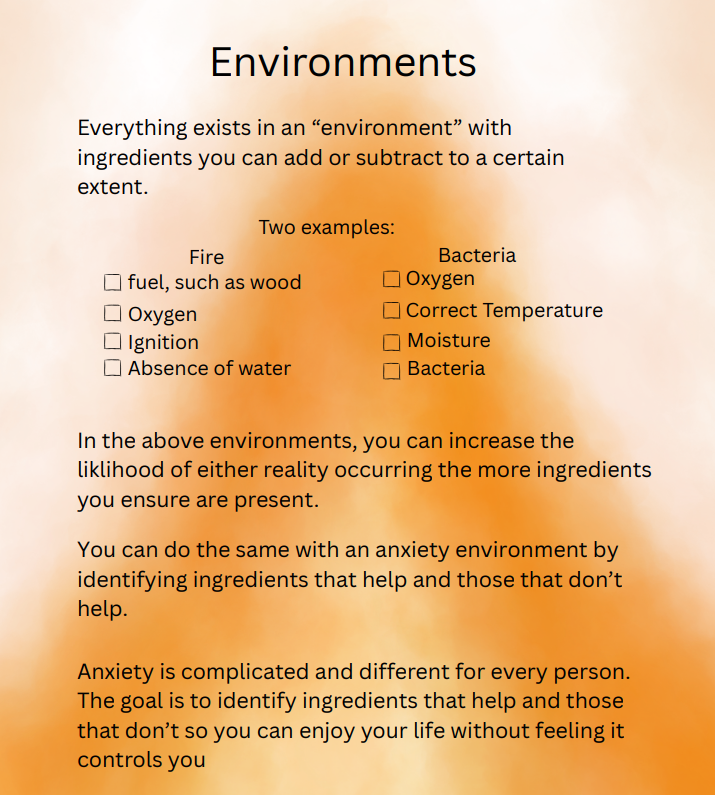
Fire requires three essential elements: heat, fuel, and oxygen. When these elements come together under the right conditions, a fire can start and continue burning. Reducing or removing one of these elements can help prevent or extinguish a fire. We actively do things to mitigate fire: we store flammable materials away from heat sources, keep matches out of children’s reach, and learn how to respond safely to different types of fires. When a small grease fire occurs in a pan, covering it with a suitable lid can help smother the flames by restricting oxygen.
The bacterial environment
Bacteria also need suitable conditions to grow. Depending on the species, these may include an appropriate temperature, moisture, nutrients, and particular oxygen conditions. We reduce certain risks by refrigerating perishable foods, cleaning food preparation surfaces, washing our hands, and preventing cross-contamination. These practices help limit the growth and spread of harmful microorganisms.
In both examples, understanding the conditions that contribute to a problem gives us opportunities to reduce risk before the problem develops. That’s not to say we completely control these environments, but by decreasing known ingredients, such as matches and warm temperatures, we can decrease them from becoming larger situations.
What Is Your Anxiety Environment?
Although anxiety is a more complicated state then fire or bacteria, you can still understand it within the framework of an anxiety environment, which consists of the internal and external factors that can influence how anxious you feel. Many of us can relate to the anxiety associated with attending a large class or training session. To make this more comfortable, we often adjust our “anxiety environment” by sitting in the back, next to the aisle, and bringing a sweatshirt to wear because they never seem to be able to regulate the temperature in larger classrooms.
External factors might include:
Work pressures, deadlines, or excessive responsibilities.
Financial concerns or uncertainty about the future.
Conflict with family members, friends, or coworkers.
Major life changes or unexpected events.
Loud, crowded, or otherwise overwhelming environments.
Insufficient time to rest, recover, or attend to personal needs.
Internal factors might include:
Repetitive worry or negative predictions about the future.
Interpreting uncertainty as a sign that something bad will happen.
Being highly self-critical or setting unrealistic expectations.
Noticing physical sensations and interpreting them as signs of danger.
Poor sleep, excessive caffeine, or using alcohol to cope with stress.
These factors do not affect everyone in the same way and it is not helpful to understand your own anxiety environment in terms of how someone else thinks of their anxiety environment. Something that creates significant anxiety for one person may have little effect on another. Even for the same person, a situation may feel manageable one day and overwhelming the next, depending on sleep, current stress, available support, and other circumstances. Anxiety is influenced by a combination of factors, not simply by the presence of one particular trigger.
The common thread in the “environment” metaphor is that when several contributing factors come together, they can increase the likelihood of a problem or make it more difficult to manage. A difficult day at work, poor sleep, financial worries, and an unresolved disagreement may each be manageable on their own. However, when several occur close together, they can add to your overall stress and make you more vulnerable to anxiety.
The benefit of recognizing these contributing factors is the opportunity to act early. Whether managing fire risk, preventing bacterial growth, or understanding anxiety, identifying the conditions that contribute to a problem can help you take steps to reduce risk before the situation becomes more difficult to manage.
Why Managing Anxiety Early Matters
Identifying your anxiety environment does not mean you should try to control every circumstance or prevent yourself from ever feeling anxious. It is about recognizing what you can influence and responding to it constructively.
There are several reasons this approach can be helpful.
You can address stressors before they accumulate.
If you recognize that poor sleep, excessive caffeine, an overloaded schedule, or unresolved concerns tend to increase your anxiety, you can take reasonable steps to address them. You may not be able to eliminate every source of stress, but you can often reduce some of the pressures that make anxiety more difficult to manage. You have control over seeking help if you aren’t sleeping well; you have control over how much caffeine you drink; you can adjust your schedule; you can ask to talk to a friend about a conflict you would like help with; you can eat healthy; and you can get exercise to release stress.
You can practice coping skills before you urgently need them.
Learning a new skill can be challenging when you are already highly distressed. Practicing skills such as challenging negative thoughts, controlling your breathing, or getting out a piece of paper and breaking down a task into manageable steps are all things you can do during calmer moments to make them more familiar and accessible when anxiety is higher.
The goal is not to assume that these techniques will prevent every panic attack. Rather, it is to build a repertoire of responses when anxiety increases. Even during intense anxiety, learning is still possible; it may simply be harder to concentrate and apply unfamiliar strategies.
You can build confidence through experience.
Confidence grows when you repeatedly discover that you can cope with discomfort, uncertainty, or challenging situations; you get it along the path as you practice, not as one big reward at the end. Confidence grows each time you learn that anxiety can rise and fall without requiring you to escape the situation, or that you can complete an important task even when you feel nervous.
Over time, these experiences can help you develop a more flexible response to anxiety. Cognitive behavioral therapy (CBT) uses structured practice to help people change unhelpful patterns of thinking and behavior, because it is not something you gain with one big experience, nor is it achieved just by talking about it in therapy twice a month.
You have to practice every day.
Identifying Your Anxiety Ingredients
Once you begin recognizing your anxiety environment, you can identify which factors are within your control.
For example, you might consider:
Thought patterns: Notice recurring worries, challenge negative thoughts that are not helping, and consider all the explanations, not just the ones you are used to. Those thoughts got there initially because you purposefully thought them. You can also think other thoughts on purpose that are more helpful to you.
Work stress: Set realistic priorities, break large tasks into smaller steps, and discuss unreasonable demands when possible. If you need to, get a copy of your job description and identify if it actually matches the tasks you are doing or are being asked to do.
Financial concerns: Identify what you can control, make a practical budget you can live with, get rid of expenses you can’t afford, and seek appropriate financial guidance if needed. If you don’t do this, either because you don’t like it or don’t know how, it will only get worse from here. This task has to be learned by everyone, but you can control how you learn it.
Relationship difficulties: Communicate your concerns to those involved, establish reasonable boundaries for which you have control, and practice these skills in your relationships throughout the week, not just once or twice. Or, you can rely on others to do this and hope you somehow benefit from them doing it.
Overstimulating environments: When you have to be in these environments, plan breaks, prepare for demanding situations, or make reasonable adjustments when needed. Understand that there is more than one way to get the things you need other than immersing yourself in an environment you know is overstimulating. A note of caution is needed here. The goal is not always to avoid annoying environments, rather, to get used to them so you can participate when you choose.
Sleep and daily habits: Establish a consistent sleep routine, exercise regularly when possible, and reduce caffeine or alcohol intake. Whatever is making these difficult is not permanent—you can find out how to improve and practice these new habits. The answer is in the practice, not the activity itself.
Professional support: Consider therapy if anxiety is persistent, difficult to manage, or is interfering with daily life. The stigma of therapy is quickly eroding and finding a therapist is not as difficult as it was just 5 years ago. Most therapists are taking new clients, have easy access to getting more information, and have a convenient way to either get a free 15-20 minute consult or begin the process to make an appointment without making a phone call. Also, several recent Federal and State laws mandate insurance companies to list accurate and up-to-date information on providers so you are not spending useless hours calling about providers who are no longer available.
The aim is not to eliminate every source of discomfort. Some stressors can be reduced or resolved, while others require you to develop new ways of responding.
An Important Distinction: Reducing Stress Is Not the Same as Avoiding Anxiety
It is important to distinguish between reducing unnecessary stress and avoiding situations simply because they make you anxious. Some situations genuinely warrant avoidance, boundaries, or changes. For example, it may be appropriate to leave an unsafe environment, reduce an unreasonable workload, or limit exposure to harmful behavior.
Other situations may be uncomfortable but important to engage with, such as speaking in a meeting, meeting new people, traveling independently, or facing a reasonable responsibility. Avoiding these situations may provide immediate relief, but repeated avoidance can strengthen the belief that they are dangerous or that you cannot handle them, when you can.
The question is not simply, “How can I avoid feeling anxious?” A more useful question is, “Is this a situation I need to change, a problem I can solve, or a discomfort I can learn to handle?”
That distinction helps you manage anxiety without allowing it to dictate your choices.
Building a More Supportive Anxiety Environment
Anxiety environments work in both directions. Things that add to anxiety build to overwhelm. Things that subtract from anxiety build calm. Rather than thinking of these as guaranteed anxiety antidotes, it may be more accurate to think of them as protective habits and resources.
These may include:
Spending time with supportive friends, family, or mentors. This gives you the time and safe space to practice the new thoughts and behaviors you will need when anxiety ramps up.
Maintaining routines that support sleep, nutrition, and physical activity. A late night every now and then, but for the most part, do what works for you on the daily.
Making room for rest and enjoyable activities. Being scheduled every day, every minute is not something that will work out for you by the end of the week.
Practicing your ability to challenge negative thoughts or beliefs. No one is going to do this for you and the thoughts don’t disappear on their own. You have to practice replacing them with something more helpful.
Get a whiteboard or a notebook so you can break overwhelming tasks into smaller, achievable steps that work for you. Again, the tasks are not going to present in a way that helps you out on their own, you are it.
Seeking professional help when anxiety becomes persistent or disruptive. Finding a therapist is easier today than it has been in the past.
Skip the step where you judge yourself and add in a lot more practice for the new thoughts and behaviors you want.
The Key Takeaway
Understanding your anxiety environment is about becoming more aware of the factors that are within your control and choosing helpful responses. The goal is not to create a life in which anxiety never occurs. It is to build a life in which anxiety does not have to determine what you do, what you think, what you avoid, or what you believe you are capable of handling.
Over time, those repeated opportunities can help you develop greater confidence, flexibility, and resilience when anxiety arises.